
Spring Cleaning— Habits, Hard Work, & How To Care Softly
Why short term goals feel exciting, long term goals feel like a saga, & how to work softer, but more intentionally.

I’ve Got To Be Honest—I’m In The Middle of A Habit Forming Saga—Some Days It Feels Like Shit
So much has changed in my world this past year, internally and externally. After 33 adult years of being highly nomadic I committed myself, finally, and on purpose, and of my own choice, to being more sedentary.1
Now, for those of you who know me in real life, you’re probably laughing. I still travel quite a bit for work, and am often filling up my schedule in a way that probably doesn’t look like I’ve shifted much. But I promise, it feels different, and that precipitates the external difference.
Right now I’m in what they would call the “messy-middle” of forming a new habit. Not a simple habit like taking my vitamins everyday or a short term habit sprint of dancing for 20 minutes a day (whoops, I actually am doing that, and my commitment at this point in the months is pretty mid). The habit I am in the messy middle is a long-term, somewhat convoluted, shift in lifestyle.
And while I can see that I am trending in the direction I’d like to go, I’d like to be clear that I am also frustrated that I cannot just plug myself into the Matrix like Neo and automatically be good at something just because I thought about it one time and decided that’s where I wanted to go.
So, in good form, when I catch myself chewing on the same thing over and over again and watch my layers of self-criticism start to crust on the hulls of my ship—I realize it’s probably time to back up, get curious, and remind myself of the cool science I love so much around how change happens.
Today for our long-form science communication post we’ll be talking basics about habit formation and practical ways to engage with it.
Let’s Start With Habit Formation Basics
As with all science communication, this is going to be vastly over-simplified for the sake of digestibility, but hopefully these broad strokes will help all of us tilt towards the sunshine of the new habits we’re trying to grow into.
Habits can be simplified down to something like this:
If we like something, we will do it more.
If we dislike something, we will do it less.
If something causes us pain, we will avoid it at all costs for the ends of the earth until life intervenes and forces us to face it again.
If something creates extreme pleasure, we will likely sacrifice most anything to perpetuate the pleasure as long as possible. We will stop doing neutral things to engage in the pleasure behavior until you cannot access the pleasureful feeling anymore, or pain shows up in some way to stop us from engaging with it.
Great, end of story.
If you read nothing else this week, just walk around with these four stupid facts in your teeth like something your undergraduate habit formation professor said that hasn’t stopped haunting you since.
Oh, is that just me?
Just kidding. My professor in undergrad only said the first two. Buddhism talks about the second two at length, and I’ve just shortened and satirized it for my own purposes. Especially the second one, I personally have had the craziest dreams where my brain likes to tell me that I’ve veered off course in my life because I’m chasing something unnecessarily full of pleasure—but that’s a blog post for another day.2
But seriously, if you wanted to simply observe yourself for a day, a week, or a month— these four sentences would probably remain more or less true. You would certainly find nuance to these sentences, but they are, in many ways, what has driven most of evolution in animal behavior.
Habits Cannot Be That Simple! Why Can’t I Stick To Anything I Try?!
So many people flog themselves incessantly about not being able to make a major shift in their lives. If this is you, please, please, please stop. Your willpower is not the problem getting in the way of you achieving the things you’d like to achieve. Your understanding of how these four habit facts interact is.
Once you understand the pattern of how these four basics of animal behavior work you will have so much more agency.
The pattern looks something like this.
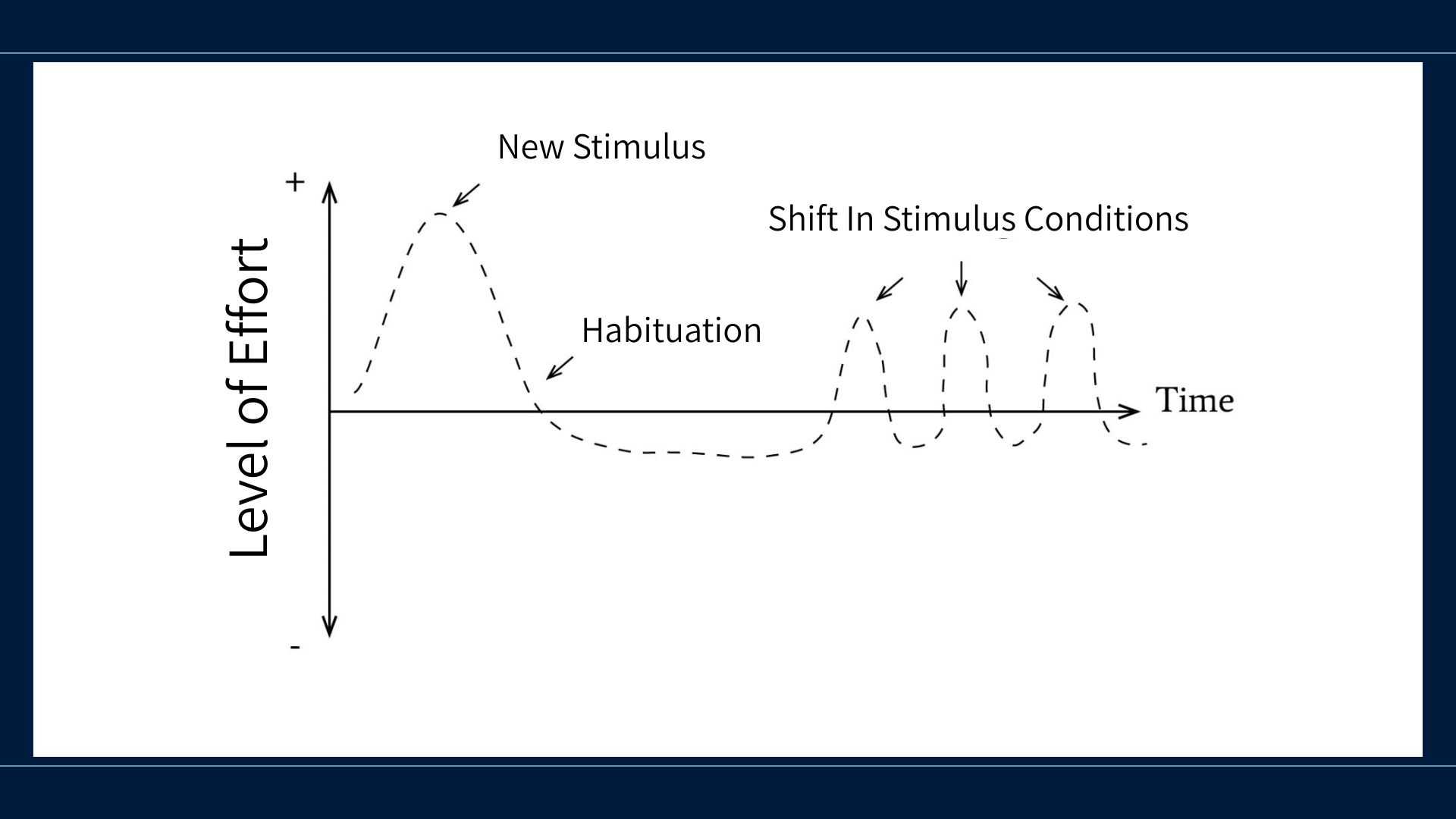
I want to name, again, that this is over simplified— but for the purposes of understanding yourself and how you interact with the world around you, this is plenty good enough in terms of a map.
As you can see, with this picture we add another layer onto what it takes to make a shift in your life—effort.
At first, when something is new in your life, for most of us that new thing starts off being labeled as good in some way. You go on a first date with someone who makes you smile and laugh really hard. You finally build up the courage to go off to graduate school. You absolutely suck at hardshell kayaking, but half-drowning in the pool with your friends feels like a fun challenge.
There is high effort involved, but it also feels good enough to keep doing more.
Until….there isn’t.
Eventually, our energy stores run out. Or our capacity finds its maximum. Or the momentum of our regular life before this new habit comes back into focus. Whatever the reason, you still have high effort, but now the new stimulus stops feeling so good.
This is usually where you stop putting effort in.
Sometimes this is circumstantial—after spending weeks on end eye-gazing with your new lover, one of you has a serious work deadline to attend to. Your effort needs to shift somewhere else for a bit.
Sometimes this is from exhaustion or because the thing that started to feel so good, starts to feel so bad—your first round of midterms in graduate school has just come and gone and you have 3 papers to write, but your brain has no more juice left to squeeze out of it so you binge-watch The L-Word, again. There is no more effort you can put towards the task even if you wanted to.
Sometimes this is where your capacity maxes out—after doing a lap on the local whitewater stretch three days in a row, your body starts to make weird mistakes and the rapids stop feeling fun and start feeling a little bit scary because you can’t entirely count on the new rolling skills you’ve worked on so hard. You stop trying to play in the waves and just enjoy riding in the easier currents for awhile. There is genuine desire to keep practicing the next hardest skill, and maybe even effort, but your body can only learn so much in a short amount of time and your skillset plateaus for a bit. This forces your effort into a workable range even if you wanted to put more effort in. The nervous system’s capacity puts a hard stop on your ability to apply more effort.
Over time something miraculous happens.
We pause. We rest. We incorporate.
Our bodies metabolize & metastasize.
This is where the magic happens.
This is why I’m so obsessed with pursuing the art of rest.
Not because rest and restoration in the ways our human brains often wander towards those words feels nice, but because something truly magical happens in this part of the process.
I use the word miraculous and magical here, not as a hyperbole, but as something I truly believe. Learning and progressing is an underrated miracle. We can scientifically understand the pattern of it, but the fact that effort over time creates new skills never ever, ever, ceases to amaze me.
And no matter how much science we have access to, we don’t actually have a clear why to answer this question.
Why does resting make us better? Stronger? Feel safer? Move better? Have more acuity and clarity?
WE DON’T KNOW.
All we know, is that it does.
So, just trust me here. It’s well documented. Over thousands of years of evolution. Over hundreds of years of scientific discovery. This is where the inexplainable happens. In the rest.
Nerdy tangent over, I digress. Circling back to this image to explain the rest of how habits work—
Once we finally bottom out on effort. We finally put the thing down. We finally rest.
THEN
When we come back to it, whatever it is—the date, the homework, the scary rapids—it takes less effort when we return.
*insert magical music cues here*
Sometimes our desire to engage with the task is also diminished, but we’ll touch on that later.
The important thing to know is that the body can now do more with less effort.
Over time, it becomes second nature. Once something is second nature to the point of not something we think about, but something we just naturally do—this is when we can finally call it a habit.
Damn, Dagny. That was a journey. I’m on board, but what can you tell me about this whole thing with the desire going down, too?
Ah, yes, you caught that didn’t you?
Here’s the secret sauce. If you can understand the concept of “habituation3” above, and mush it together with the four main truths of animal behavior—You’ve not only got the map to the treasure, but you also have the keys to the chest.
It’s simple, but it isn’t easy.
Let’s review the four truths of animal behavior:
If we like something, we will do it more.
If we dislike something, we will do it less.
If something causes us pain, we will avoid it at all costs for the ends of the earth until life intervenes and forces us to face it again.
If something creates extreme pleasure, we will likely sacrifice most anything to perpetuate the pleasure as long as possible. We will stop doing neutral things to engage in the pleasure behavior until you cannot access the pleasureful feeling anymore, or pain shows up in some way to stop us from engaging with it.
Now let’s start to put this knowledge together.
The best thing we can possibly learn how to do when it comes to building new habits is to try our best to put in as much effort as we possibly can while something feels good, and then stop before it turns into pain.
If we do this many, many times in a row, almost nothing can stop us.
But that’s unfortunately not how life works at all, is it?
Maybe your life does, but mine most certainly does not.
I am inherently a little cocaine rat4 (term coined by my best friend Haley). I will do the things I love to do and find inherently rewarding until my body gives out and dies or the pain of finding the proverbial cocaine is so uncomfortable that I can no longer drag my little rat body to the cocaine dispenser because I understand the consequences too deeply in my bones.
In other words, I have a hard time stopping something before it feels bad or painful and like I never ever, ever want to revisit it again.
Then I crash. I have a full come apart. Then I rest. Then I remember why I wanted it in the first place and the cycle repeats ad nasuem.
If this is you, too— this is normal, although our relationship to this dynamic might not be healthy or normal. It’s at least, very human and learning our own tendencies is important.
What typically happens when we don’t tend to this dynamic carefully is we find ourselves in a moment where something feels unpleasant (so we do less of it) and it still requires a high amount of effort to engage with it in the way we want (so we end up with no effort left to give towards it).
This is a tough dynamic to have going on, especially towards something you thought you really wanted.
The amazing person you’ve been dating, but now you’re past the honeymoon phase and real life is smashing both of you in the nose.
The graduate program you’re 1 year into and realizing that you’ve got a minimum of one year left and you’re the most depressed you’ve ever been.
The hardshell kayak you’re so proud of yourself for crawling back into, but now you can’t seem to commit to a day on the water, even though it’s the thing that brought you the most joy the winter before.
This cognitive dissonance between the desired object or activity and the feeling in the body, and the lack of energy you might have to put towards it all feel out of sync. AND THIS IS ACCURATE BECAUSE THEY ARE OUT OF SYNC.
But at this point, most people make the mistake in thinking that this feeling means that something is wrong, broken, or misaligned. Most people at this point believe that there is something wrong with their willpower at this point. Most people might label themselves as “bad at [insert activity here]”
Most of the time, these things could not be further from the truth.
In fact, usually a few things will shift this back into a more.
Less Intensity, A Little Softer, More Rest, Intentional Return
Most of our biggest accomplishments in life do not happen in a single moment. We find ourselves deeply proud and satisfied with our work when we can look back and see every single moment we said “yes” to returning to something we value, even if it was hard.
Again, let me be clear, I’m not actually advocating for “pushing through” because you can see how bad you want something. In fact, I’m actually saying if you really, really want something—you must learn to work with this pattern. Not against it.
When you really, really want something you must learn to go slower, try softer, rest and balance between trials, and return intentionally over, and over again (even, and especially when you do not feel like it).
Like I said,
It’s simple, but it isn’t easy.
I have to admit, when I zoom out like this when I’m in the messy-middle, I’m not only filled with pride, but it also re-motivates me to continue.
As someone who is currently in the messy middle of their process of change towards some bigger, loftier goals—I have felt myself dragging my feet this winter. Sometimes just a little bit. Other times like a full-blown adult temper-tantrum aimed at myself and my annoyingly thoughtful and patient boss (it’s me. I’m that boss).
Writing this article made me feel substantially more emotional than I expected.
It also, helped me feel more proud of the work I am doing, the work I hope to continue doing, and the work that I am heading towards that I can’t confidently put in the “work I’ve done” category, yet.
If you’re a human (which, with the increase of AI bots liking and commenting on my substack, I’m not entirely sure you are) — you’re probably in the messy-middle of something, too.
I hope that reading this today helped you find some self-compassion.
You don’t hate doing the things you value—you’re in a very-well-documented process of learning. You’re not failing at what you love—you might be resting up to unfold the next layer with more finesse, ease, and mastery. You don’t need more willpower—you are just moving at a slower pace than you’d prefer (and that shows love more than it shows anything else).
You are not lost—you have both the map, and the keys.
Keep going.
Take smaller steps.
Stop and smell the flowers along the path.
Kindly return, repeatedly.
Although it’s simple, and certainly not easy, whatever long journey you’re moving towards is also, worth it—I promise.
With courage, kindness, and the tiniest, consistent steps forward—
Dagny Rose

Our Community Announcements:
Freeflow River Camp — August 22 - August 25 — Freeflow Institute — An adventure for women of all backgrounds, focused on cultivating river skills, resilience, and tools for creative expression in a supportive, connective environment | Women Specific | Registration Ends May 10
Embodied Movement Program — Kicking off April 1 — Sacred Ally — For Missoula locals, this is an exciting way to get into the body and explore how your body feels like moving through space. Every single movement facilitator involved in this program is an experienced gem in their own right. I’m not on the regular schedule but I’ll be subbing quite often and plan to put a regular class on the books in the fall. Come find your own, authentic movement practice.
I’ll for sure be subbing:
TODAY, THIS MORNING FRIDAY April 17 — 9:00 - 10:00
Come wiggle with me
Ground: Forest Retreat — May 29 - June 1 — Yoga, Sauna, Music, Great Food— My dear friend, and extraordinary yoga facilitator is hosting a cozy, spring yoga retreat. The cabins are built right into the hillside an hour outside of Missoula and it will be a sweet mixture of yoga, food, sauna, and time on the land. Her very affordable pricing keeps this yoga retreat accessible and is absolutely worth checking out.
This sub-section of The Art of Rest, is all about—you guessed it—The Rest.
As a trained sleep scientist and mindfulness teacher & researcher, here we explore everything related to rest. Whether we are unpacking the newest evidence-based sleep health tips, exploring day-to-day tools for bolstering and protecting rest, or sharing everyday mindfulness practices, “The Rest” is going to regularly touch into what a restful life is, and how to move towards one5
Don’t worry, it’s almost certainly a phase.
A recent one I had this spring was that I was at a party where cocaine was EVERYWHERE like a tiny snow-storm and that I had to call a friend to come pick me up because I knew it was going to just keep snowing at the party I was at.
Which, again, is substantially more complicated than this article has time to unpack
I don’t actually do cocaine. My dream-maker just seem to like the metaphor of it