

Resting Into Grief
How Grief Can Open Space For A More Vital Life & A Community Grief Ritual Announcement

Please note: When this posts, I will be away helping with a Women’s Wilderness Vigil with The School of Lost Borders. Please be patient with my response to this newsletter, and I look forward to getting in touch when I’m back around.
If you’re interested in The Art of Rest’s upcoming workshops:
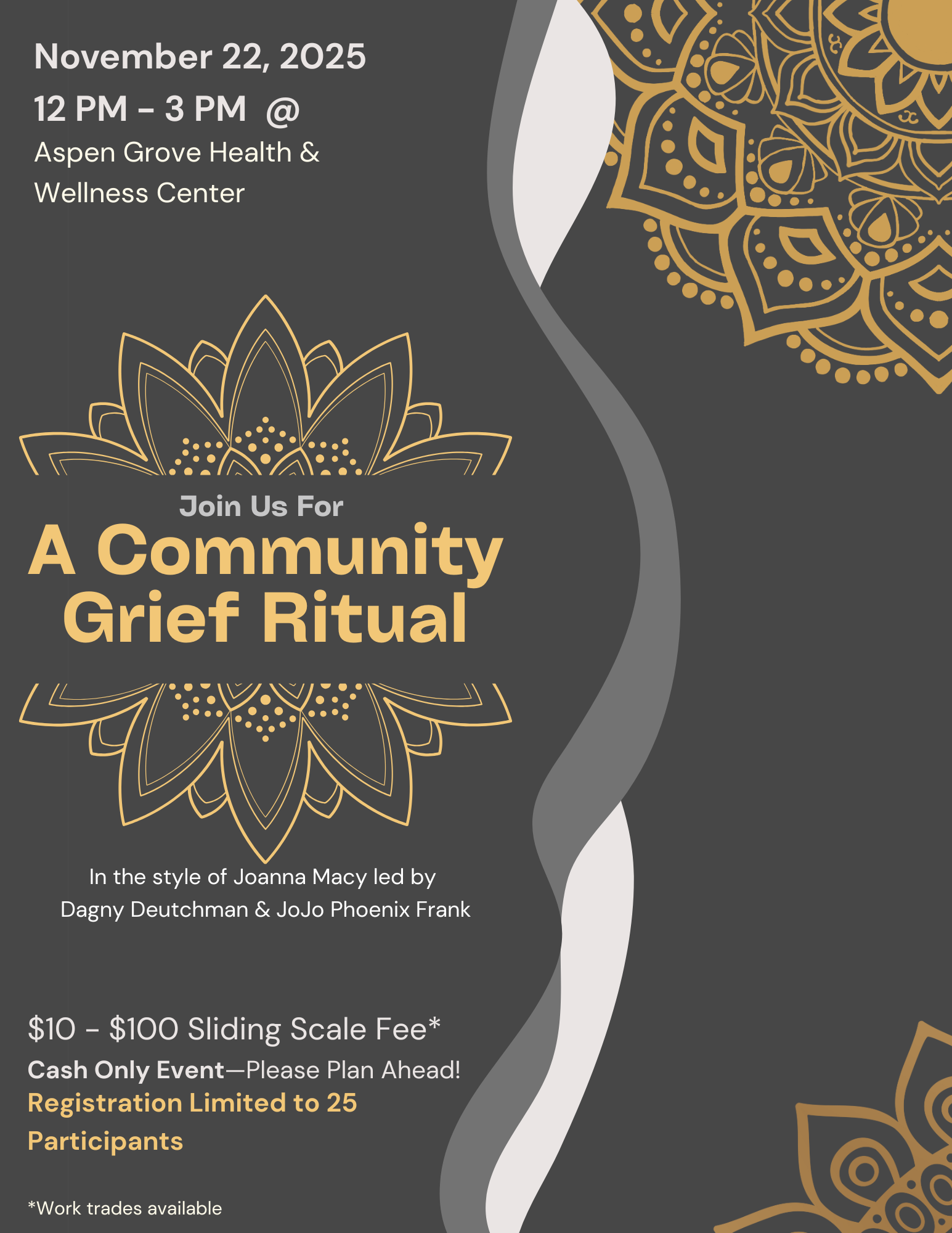
Missoula Community Grief Ritual - Saturday November 22, 2025 from 12:00 PM - 3:00 PM at The Aspen Grove Wellness Center - In the style of Joanna Macy
Mythopoetic Mapping: Locating Ourself Through Myth, Story, & Folklore - Sunday December 14, 2025 from 5:00 PM - 7:00 PM - We’ll be exploring the Norwegian tale of Tatterhood <3
Half-Day Winter Solstice Retreat — Sunday December 21, 2025 from 12:00 PM - 5 PM - We’ll be exploring cycles of the year and celebrating skillful means of heading into the depths of winter. —More details coming soon
16-Week Winter Experiential Book Club: Women Who Run With the Wolves at Sacred Ally — Runs every Sunday starting January 4, 2026 - April 19, 2026 - This is my favorite, and most popular offering of the year. Hope to see you there!
Ah yes, welcome back to Wednesday where you’re never quite sure if you’re get something whimsical or weighty. Although everyone has a slightly different connotation with the word and experience of “grief,” I’d love to offer that today we venture into this topic as part of the broader human experience.
I’d love to normalize it.
I’d love to make this something we tend to regularly for the sake of emotional hygiene.
I’d love to curl up in a blanket next to it some days and say
”Hey Grief, Thanks for being here….what are you trying to tell me?”
I’m not sure if any of you regular readers remember, but over the summer, two profoundly inspirational people in my life died within the same week. One was the poet and queer activist Andrea Gibson, and the other was buddhist practitioner and climate activist Joanna Macy. I wrote a little blog about practices in grief and gratitude as I worked to make sense of my own loss of these two inspirational people. In the post, it felt clear to me how to honor Andrea, and I was still listening for good ways to tip my hat to Joanna and her lifetime of work.
About a month ago, my friend Jojo and I were chatting at the library while we were co-working, and they randomly mentioned they had been wanting to offer a Joanna Macy grief-ritual. Jojo asked if it was something that I might be interested in co-facilitating with them.
Since we’d never talked about Joanna Macy before, nor had we ever co-facilitated an event, I was shocked at the timing and serendipity of the conversation and within a week, we put something on the calendar. It also felt like a sweet way to bookend my year. In February I participated in my very first 30-day silent retreat with one of my favorite meditation teachers, Rupert Marques, who worked directly with Joanna Macy for many years while she was alive. One of my last conversations with Rupert before I left from a month of silence was asking about moving through my own insecurities around facilitating work like Joanna’s.
“It’s been life-saving to me, but I almost never hear anyone openly talking about grief in our general culture. Won’t it seem grim and depressing to most people? ” I asked him.
“I think people are more hungry for this work than you think,” Rupert replied. “And even if just one person benefits, that one person is important.”
Heading Courageously Into Despair….Together— A Peek Into Joanna Macy’s Legacy
Joanna Macy was most well know for her “despair work,” — which is more commonly recognized as the Work That Reconnects1. This work is a process for transforming feelings of despair about the world’s problems into compassionate action. The process aims to help individuals acknowledge and process their grief, anger, and fear for the planet, viewing these feelings as a sign of care and interconnectedness rather than weakness or something to be ashamed of, turn away from, or repress. Through a spiral of four stages—gratitude, honoring our pain, seeing with new eyes, and going forth—it aims to strengthen people for continuing on with their activism work—or for others, just making it through their complicated day-to-day lives.
While Joanna Macy has a large arsenal of work, her most popular frameworks function something like this:
Reframing despair:
The work reframes pain for ourselves and for the world not as a private feeling meant to paralyze, but instead as a sign of compassion and connectedness that can be used as a source of energy for large-scale change.
Acknowledge and voice pain:
Participants are given specific structured containers that give the opportunity to voice their personal and collective fears and grief in a supportive group setting. There is no pressure in these settings to share, and there is an emphasis on the importance of “being a witness” to the process as well. Either way, the work asks us to be in close contact with emotions, sensations, and experiences that we spend much our daily lives working to avoid.
The Spiral of Experience:
Joanna’s general work follows a spiral structure with four stages:
Gratitude: A moment to appreciate life and interconnectedness.
Honoring our pain for the world: Expressing and witnessing collective grief, fear, and anger about the state of the world.
Seeing with new eyes: Engaging with different perspectives through a variety of thought exercises.
Going forth: Moving into action with newfound clarity and strength.
Active hope:
The work is rooted in the concept of “Active Hope,” which is not a passive feeling of ‘hoping for a better world,’ but instead, a practice of facing challenges with courage and determination. It’s recognizing where we feel fear, and showing up to the way we’d hope for the world to change anyway.
How Do We Rest Into Grief? Well, Just A Little At A Time, Whenever We Can, And As Communally As Possible
Over the past year or so, I’ve written a number of times about how overarching themes of trauma might impact someone’s ability to rest. Whether this is childhood trauma, an overactive fawn response, recovering from natural disasters, or overlaps between things like sleep and suicidality— it’s clear that our ability to rest is quite intertwined with how our overarching and underlying emotional health is doing.
Both our overarching and underlying emotional health is something that needs regular care and maintenance, including and maybe especially, our relationship to grief.
I very purposely try not to get too in the weeds of politics or current events in this writing space—there are plenty of people doing that, and many of them are substantially more qualified to be doing so—however, it would be remiss if I didn’t explicitly say that the crazy shit currently impacting our friends, family, neighbors, fellow citizens, and onto people all over the world undeniably has an impact on whether or not we are able to rest.
It is imperative that have somewhere we can retreat to with a sense of agency for processing the chaos of the world around us, or the ungovernable sensations inside of us. Even the act of not engaging with political or world news, ignoring it, or setting boundaries around it, takes energy. Engaging with it skillfully takes energy, too. We are not an endless flowing cup of energy that can indefinitely engage in managing these feelings ad nauseam.
Taking the time to participate in despair work, grief work, and emotional processing can help us make sure we’re doing our best to responsibly navigate our own emotional reactions and responses to the world around us, and engage with our internal and external worlds in a structured way. When we give that energy somewhere to go, we can show up to our lives more fully with intention, vitality, clarity, and a bit more energy to engage in these issues. When we exert our energy with thoughtfulness, we’re more likely to have greater impact with lasting effects.
Grief and Belonging
Finally, it feels important to note one of the most important pieces of Joanna’s work—belonging.
Most of us don’t dare venture into our biggest feelings because we are unpracticed at being with our despair, our rage, our grief. It makes sense that we’d be sloppy and unskillful with these big emotions outside of a container like this. I’ve written on here several times about the links between our ability to rest, our sleep-health, and our sense of belonging. Part of why we don’t often express big emotions, like rage, despair, or grief, in community is the fear of being judged at the very least, and fully ostracized at the very worst. We’ve all had the experience of coming to blows with someone in our lives that we are close to, that we love very much, and how when we’ve been unskillful with these emotions in the past—it probably really harmed someone.
Maybe we were the person on the end of harm from someone else’s unskillful means of navigating grief, rage, or despair. It makes sense we’d want to avoid them all together.
Additionally, most every person on the planet has some level of sensitivity to feeling like they might be a burden to their closest loved ones, their co-workers, and their larger community if they open the faucet on these emotions. Thus, it makes a lot of sense that we often try our best to keep those biggest emotions all to ourselves.
Entering into a community container which has the explicit intention of holding large emotions without judgement, without being ostracized, and without the ability for other community members to even comment or interact directly on your experience, automatically gives the nervous systems a permission slip. There is a freedom to express what may otherwise not feel appropriate to come out in other settings.
What kind of safety to express might we find in ourselves if we know that expressing our most despairing, rageful, or grief-filled emotions wouldn’t push other people away?
How might we learn to skillfully observe, love, and accept those despairing experiences when we get to touch into them more regularly? Or frankly, at all?
What might shift in our hearts if we’re willing to see others in their despair, rage, and grief as well without trying to fix, change, or comfort someone “back to normal?” What might happen if we trust the natural rhythm of riding these waves into shore?
A Sense of Exhaustion
In many cases, people often find themselves at the end of a grief ritual having some varying sense of exhaustion.
To “exhaust something” means to use it up completely or deplete its energy, resources, or possibilities. It can also mean to discuss or explore a topic so thoroughly that nothing more can be said. Additionally, in mechanics, “exhaust” refers to the process of expelling used gases from an engine.
Now, I don’t know about you—but when I’m experiencing rage, grief, or despair…I’d like to exhaust it. I would like to give it somewhere to go. I would like to completely use all of that despair up so that I might be able to put it in the compost heap for something new and wiser and more beautiful to grow back later.
If something has been weighing on me, gnawing at me, or sucking out all of my life force slowly through my nose—I can’t think of giving it a better fate than expelling it through the engine of my body and letting it float off into the ether.
I also, personally, don’t mind the type of sleep, or dreams, I often receive when that feeling of exhaustion hits.
It feels well-earned.
There’s No Wrong Way To Grieve
Community grief rituals are not for everyone. Some people prefer to navigate their grief in solitude. Others prefer a private interaction between themselves and a therapist, or spiritual teacher. There’s no wrong way to grieve. Truly.
If you’re in the Missoula area and you feel like you might want to join us in mid-November—the whole of you is welcome there.
And if you’re not in Missoula, and you’re just a patron of The Art of Rest substack from afar, first of all, thank you for being here. It’s lovely to have you bear witness to how we’re pursuing The Art of Rest. I’m grateful to have you participate in a conversation around grief and around rest.
But more importantly, I’d love to learn from you on how you’re grieving, raging, and despairing wherever you are, too. Are there things you do to touch in regularly? Tendencies you have when these feelings get backed up? How does this ebb and flow with your ability to rest.
If you have something to share,
I’d love to catch.
In the meantime,
Whether you’re feeling whimsical, or weighty, or somewhere in between.
I hope we’ve normalized a bit of grief today.
I hope it creates room for something new.
All my love,
And a bit of squirmy discomfort that I’m always trying to navigate through,
Dagny Rose
This sub-section of The Art of Rest, is all about—you guessed it—The Rest.
As a trained sleep scientist and mindfulness teacher & researcher, here we explore everything related to rest. Whether we are unpacking the newest evidence-based sleep health tips, exploring day-to-day tools for bolstering and protecting rest, or diving into a world of dreams, “The Rest” is going to regularly touch into what a restful life is, and how to move towards one5
Theoretical basis:
The work draws on systems thinking, deep ecology, and Buddhist philosophy, which emphasize the interconnectedness of all life.
For more information, you can read an introduction to the Work That Reconnects on the Second Renaissance Forum. To learn about the work in more detail, you can explore the website of Tricycle: The Buddhist Review. You can also find books and articles by Joanna Macy on The Commons Social Change Library.