


If you’re interested in The Art of Rest’s upcoming workshops:
Ritual Dreaming — Friday December 19, 2025 - This is our monthly, community dream sharing container hosted at Ritual Yoga. We’re so excited to be partnering with them for the upcoming calendar year!
Half-Day Winter Solstice Retreat — Sunday December 21, 2025 - Ritual Yoga —We’ll be exploring cycles of the year and celebrating skillful means of heading into the depths of winter.
**NOW OPEN FOR REGISTRATION** 16-Week Winter Experiential Book Club: Women Who Run With the Wolves — Runs every Sunday starting January 4, 2026 - April 19, 2026 - This is my favorite, and most popular offering of the year. Hope to see you there!
Welcome to December!
Whoa—friends. Somehow, it’s a Wednesday in December. How could that possibly be? I swear that a few mornings ago I woke up and I was looking down the barrel of March and things were still frosty and sleepy outside. Things are certainly still frosty and sleepy outside my window today, but so much life has happened in between. I wonder if you’re feeling the same way.
We’re going to be continuing our theme of reflection posts to set us up for a more intentional 2026. In mid-November we started with A Place Poem to get us into a creative space of noticing where 2025 has taken us. A few weeks ago we did a bit more intentional checking in with ourselves around what felt challenging this past year and what created a sense of ease.
Today we’ll be thinking about boundaries around our space and time as a way of creating rest, ease, and vitality, especially during the holiday season.
Let’s get to it.
Boundaries
In a world where so many of our words get co-opted by social media, popular press, pop psychology, I often love to take a moment to break down a word we hear all of the time and contemplate a bit around, not only what does this word originate from, what does it mean in the common vernacular now, but also…what does this word mean to me? What is my relationship with it?
Boundary in its seminal use in English comes from a similar word in French that refers to the limit or landmark of something. Once it was pulled into the English language it often referred to the ending of one thing, and the beginning of another. As we might guess in a colonial time, this often was used in the acquisition of land. In our “post” colonial world, most of the land has been taken up already and rearranged and in our day and age of woke, social media use, we’re more likely to hear the word referring to an emotional or moral boundary, where it has the connotation of being “a behavior, act, or ethical consideration that is unacceptable to cross.”
When I think about what a boundary means to me, I often define a boundary as the distance between me and someone else or something else that allows me to engage with it fully and authentically with kindness, care, and curiosity.
Now, it’s taken me a long time and a lot of different iterations before I’ve come to this definition. I assume I’ll learn some lessons down the line and it will surely change again. But for right now, this definition of a boundary works really well for me. In general, it’s more of my ideal scenario of a boundary, rather than what happens in the ungovernable world of our day-to-day lives. It’s what I strive for when I have my fullest capacity and it’s what I return to when I find myself feeling heightened emotions of bitterness, resentment, and anger. It’s a way to re-locate myself when I’m burnt out.
Boundaries as a Tool for Rest
This brings me to the part where I like to get nerdy. Y’all should know at this point that I couldn’t stop right there. So diving into the science we must go!
Perhaps in a previous form of culture, boundaries may have been more fluid. Or more aggressive and obvious. Or occupied less of our brain space because the collaboration for survival, was more important than whatever modern tenderness we face today. It probably depends on which evolutionary psychologist, or shaman, or person who grew up in a more intact culture that you ask. What feels true for many of us today, is that learning where our edges our in our work, our indulgences, and our personal relationships is imperative. It is also true, that many of us have some tough edges that could be softened, rearranged, or re-negotiated from time to time because they’re from something old that no longer serves our current goals.
But I digress.
The point here, is every day we wake up, we only have so much energy to spend. Many things in our lives are tugging at our limited attention span. Some of those are internal, some of those are external, but all of them require an energy exchange. Some of them even give us energy. Most of them take some energy.
This energy exchange is inherently neutral and impacts us in big and small ways.
The Basics: Energy, Mood, & Affect
This is somewhat oversimplified, but what you need to know is this—
As we’ve already said—on any given day we wake up with a certain amount of energy and attention
On any given day we are also likely to have a prominent mood we are in (think of this as our emotional “climate”)
And on any given moment of any given day, we also have a prominent affect (think of this as the our emotional “weather,” which can change in expression moment-to-moment)
The combination of these things all play together in our decision-making across time. Day in and day out, whether we realize it or not, these three factors are often in the driver’s seat on how we navigate our lives. Sometimes we are conscious of it, and use this information to set clear boundaries with ourselves, with our work, with our indulgences, and with the people we love (or sometimes, especially with the people we definitely do not love).
Much of the time, however, we are not that conscious of these dynamics and how they impact us. We let the moods, affect, and energy resources run our lives, rather than living in a give-and-take dance with them.
To skillfully use boundaries to help us bolster our decision making, we probably want to understand a little bit more about how our energy, moods, and affect might be interacting with our nervous system.
The Window of Tolerance
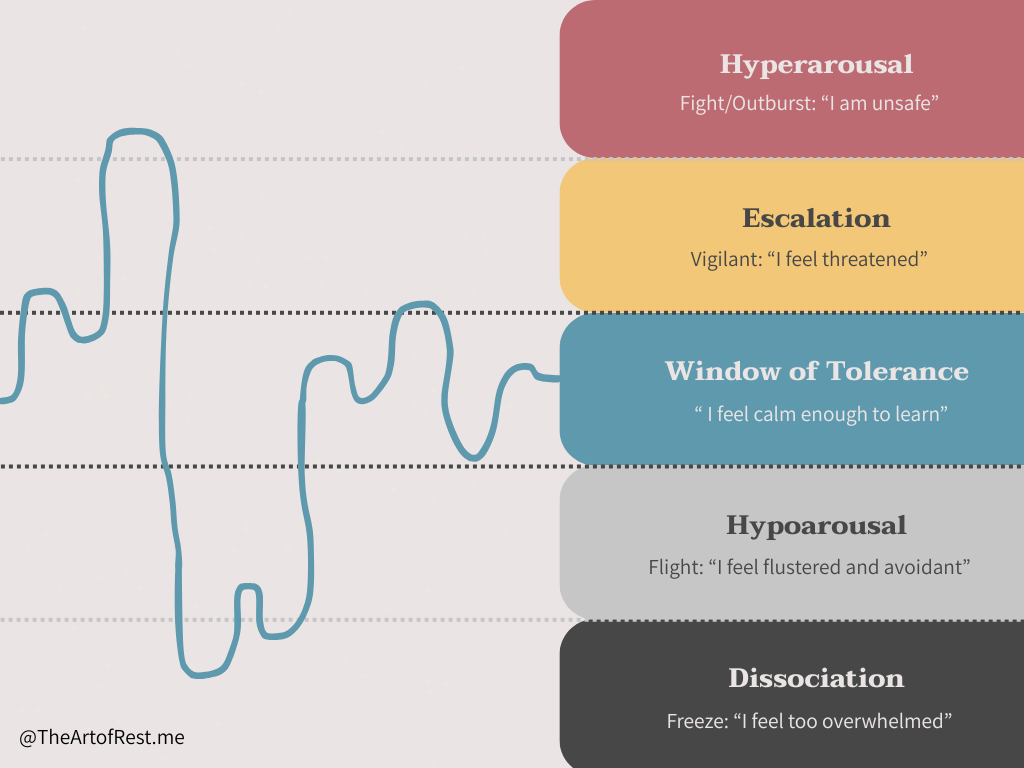
Now, to add another layer, let’s talk about our window of tolerance. Our window of tolerance is based off of several scientific theories all kind of mushed together, and this visual representation is based primarily off of polyvagal theory1, the window of tolerance and theory of learning, and the science of animal learning behavior2 — specifically as it relates to the formation of new habits and how stimulus response weakens (or becomes more automatic and easy to integrate) over time.
What I like about the visual representation of these theories all together is a reminder that we change internally all of the time based off of how much internal energy we have and based off of our external circumstances. An infographic like this helps us be able to point to a place on this graph and go “oh, I’m probably there today!”
If that feels difficult with only the pictures, here’s another one with slightly more details on what else these different nervous system states might look like.
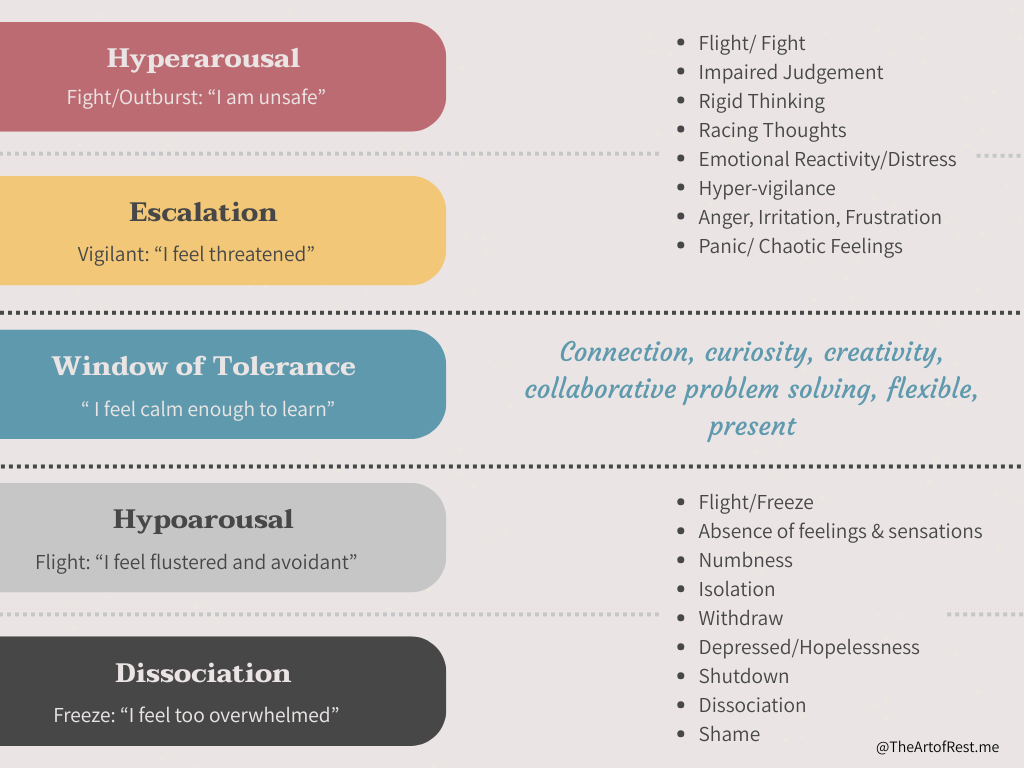
When I’m teaching this information to folks or when I’m working one-on-one with people, I try very hard to emphasize that there is not a “better” spot to be on this map than others. It is not morally superior to be “within your window of tolerance” nor is it “bad” to be somewhere floating in dissociation or hyper-arousal. Yes, we are responsible for our specific behaviors while we are in those places, but being in those different levels of activation is just information for us to consider what our needs, boundaries, and capacities might be.
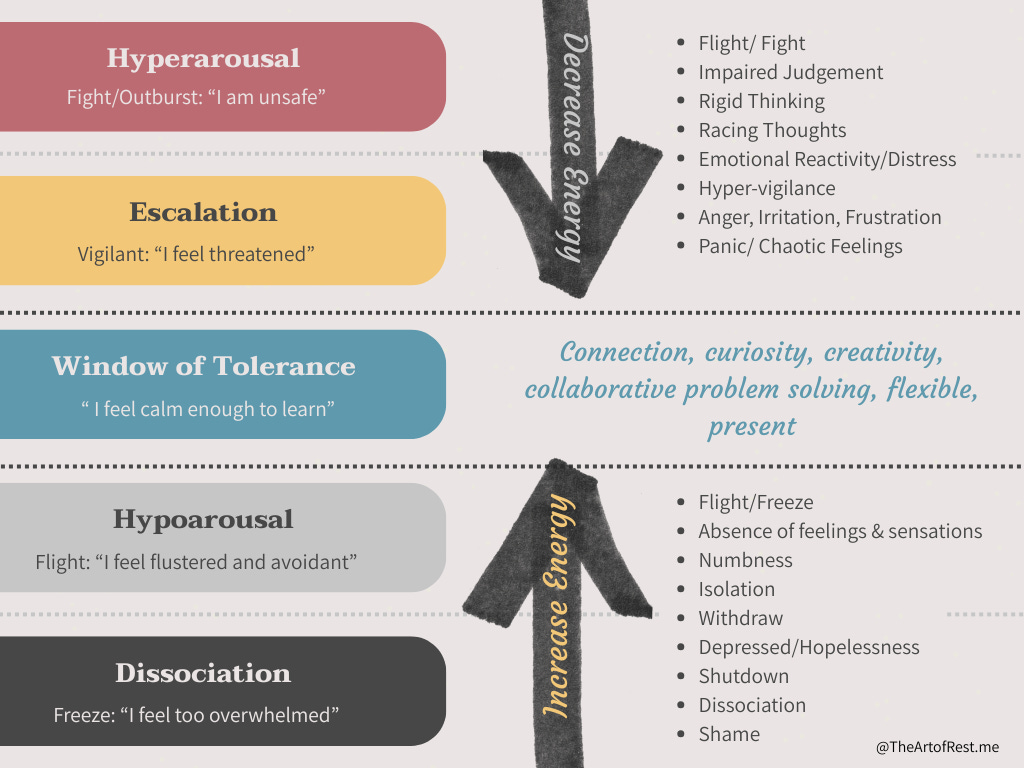
Once we can point to where we are, we can then discern which boundaries are the most appropriate to make sure that our energy is going where we would most prefer to spend it.
The Holidays Are Upon Us—A Perfect Boundary Practice Ground
“If you think you’re enlightened, go spend a week with your family“. - Ram Dass
To get straight to the heart of putting these concepts all together into practice, we have one of the most perfect settings to get in some real-world examples. Whether you choose to spend the holiday season with your family or not—the holiday season often stirs the pot for most people.
Personally, my process might look something like this:
I locate my version of what a boundary is. Which for me is the distance between me and someone else or something else that allows me to engage with it fully and authentically with kindness, care, and curiosity.
I notice what holiday situations I visualize which situations, or interactions might pull me out of this nervous system state of care, curiosity, kindness, and connection —aka my “window of tolerance”. From there, I locate where the edges of what I am willing to do, and what I am not willing to do show up. I can make decisions ahead of time about external pieces I might have control over, and I can also make internal decisions around how I want to behave, regardless of other people’s behavior.
This can be as simple as something like: “When I go home for the holidays, I will be renting an airbnb so I can maintain my personal space.”
Something slightly more nuanced like: “when I am staying at my family’s home over the holiday season, I will need to excuse myself for 2 hours a day to get some exercise and alone time in so that when I am spending time, I can be fully present with them. I will be clear about my plan with everyone else, so they know what to expect.”
It could also be something more robust like: “if [insert relative here] starts to speak about [insert frustrating behavior here] I will remind them one time that I’m not interested in talking about that topic. If they don’t stop, I will politely tell them I’m done having this conversation and then get up to to help with the dishes”
The process won’t ever be perfect, but it at least gives us a place to start.
This process gives us permission to listen to our body’s innate cues, and then behave in a way that help support what our body is telling us.
It also helps us bolster our own sense of agency, which in turn, actually can widen our window of tolerance over time.
So if you were to ask yourself a couple of questions for the upcoming month, they might go something like this:
When I think about the month ahead, how do I feel about my overall:
Energy levels?
Mood?
Current affect?
Do these mostly fall inside of my window of tolerance? Or outside of my window of tolerance?
If it falls outside of my window of tolerance, which side of the spectrum does it trend towards?
After reflecting on the questions above, if I were going to create one boundary to help give myself the gift of space—what might I need?
Sending You Space
I hope as the year draws to a close, that the holiday season is something you’re looking forward to. Whether you’re spending it with the family you love, or you’re taking that time to create extra nourishing space for yourself, your friends, and your favorite cat—I am wishing you the space that gives you ease, restoration, and care.
And if the holidays are a time of year that leave you with the squiggles in your stomach, I hope this information empowers you to create the boundaries you need (both internal, and external) to take fierce care of yourself, in whatever way that looks like.
With some space,
and some compromise to lean into connection,
Dagny Rose
This sub-section of The Art of Rest, is all about—you guessed it—The Rest.
As a trained sleep scientist and mindfulness teacher & researcher, here we explore everything related to rest. Whether we are unpacking the newest evidence-based sleep health tips, exploring day-to-day tools for bolstering and protecting rest, or diving into a world of dreams, “The Rest” is going to regularly touch into what a restful life is, and how to move towards one5